The Barpali Days

This blog is the Facebook of Barpali which picturise its "life" and "culture". It was a "palli" or a village a century back where the all time great Oriya poet swabhaba kabi Gangadhar Meher had taken birth. Now this bustling little town is renowned world-over for the weaving of Sambalpuri ikat handloom fabrics. Agriculture is its prime economy. And when you happen to visit this little town don't miss to taste Chaul bara.

Breaking

Jun 6, 2012

10:21 PM

EXCAVATE THE CURIOSITY IN YOUR CHILD


[This article has been published by India's premier ladies magazine "The Women's Era" in its 1st May 2012 issue]  

Every growing-up kid has got the curiosity to know about the unknown things. In fact it is the curiosity that helps a kid of a tender age to explore the knowledge. It is this knowledge, which in turn helps them to build-up life successfully. I got my nephew Sreyanshu. I have been watching him closely since his birth. This kid of six years old is perhaps the naughtiest kid on earth. Like any other kid, he is very demanding. All his wishes need to be fulfilled instantly; otherwise he creates a war-zone at home. Whenever he sees any new toy in the hand of another child, he would start nagging to buy it. The moment you buy it, he will go on displaying his price possession to one and all, at home and on the street. But before the day ends, he breaks it into pieces. Either he will remove the battery of the toy-car, or he will pull out the head-light or take-out the wheels. The following day he starts the jumble game. He will invent a never seen before toy, by amalgamating the broken parts.

He would always share with me his secret desires and wishes which go unfulfilled by his parents. Initially I used to buy a toy whenever returning from a trip. But one day when I discovered four cardboard boxes full of broken toys beneath his bed, I stopped buying anymore play things for him. As a consequence of which I lost the popularity in his life compare to his Karun Chachu, who often brings expensive imported toys while coming from New Delhi. He often asked me to buy one mati-kudda (earth-excavator) for him. But I was reluctant, as everything goes to the dustbin. I made him agree to my condition that, he will donate the broken toys to the poor kids on the street, who fails to buy toys. Finally Sreyanshu donated a trigger-less gun and a wheel-less car to Bibhuti a poor kid from the neighborhood.

[Sreyanshu]

Finally this June 4th (2010) evening he ran-down to me with excitement to inform that, there is an  Monster like machine on the street. He saw this yellow coloured earth excavator for the first time in his life, as  these machines are unseen in the middle of a small town. These are generally used in the construction of roads or in the open-pit mines. When we both went to check, found a mammoth machine leveling the ground for the upcoming Sital Sasthi Jatra (fair). He was jumping with the excitement to watch this monster like machine at work. He told me to buy this yellow coloured machine for him. I looked at his eyes to say regretfully, I don’t have Rs.30 lacs or so, to buy it.


He was disappointed, but kept on narrating about his wild imaginations of how powerful this machine is. We were watching the excavator from an elevated place near the road, when it neared us I waved my hands to the pilot to stop it. The dinosaur like machine halted, I took Sreyanshu near the machine. I asked the pilot to switch-off the machine by waving my hands as nothing was audible. I said “LIFT PLEASE”. The pilot of the vehicle was puzzled and at the same time got excited. He opened the doors to invite this kid. But Sreyanshu started getting nervous. I assured him not to fear, as I would be watching him from a distance. When the kid entered the cabin, the pilot shut the doors and started the engine. For 15 minutes or so he was in this monster like machine, to till and level the ground. Finally when the machine returned, Sreyanshu got down from the vehicle safely with the sparkling eyes. I asked Sreyanshu to say thanks to the pilot. And he did so.

While we were returning home this kid  told me, “ Kiran Chachu don’t worry, when I have enough coins in my kiddy-bank I shall buy it on my own. And I shall give you a ride in it.”

This is how the elders should encourage kids to fulfill their hearts desires. I may not have bought a excavating toy for him, but I helped him to excavate the curiosity that was hidden within him. With money you might be able to buy toys, but could never buy knowledge or the happiness.

[the cover page of 1st May 2012 issue of The Women's Era where this article has been published]
E.Kiran Mohan(The writer)
C/o.Dr.E.R.Rao(MD)
Tehsil Chowk,
At/PO: BARPALI – 768029
Dist. Bargarh, Odisha,India

May 15, 2012

10:38 AM

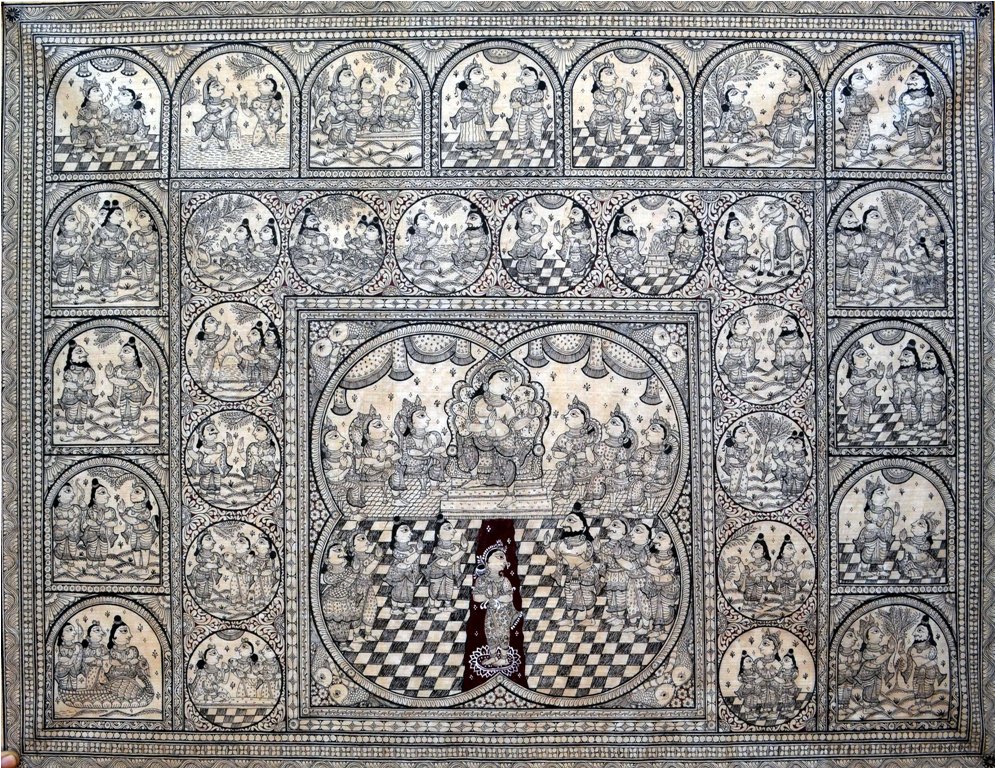
Pattachitra paintings by Pranab Narayan Das


[The Trinity - Lord Jagannatha, Balabhadra and Subhadra]


[Mukhasala-The Gokuram of a temple]
[Lord Jagannatha as Vishnu]
[Dancing Ganesha]

[Jugal Rasaleela]
[Lord Siva at the feet of Maha Kali]
[Goddess Durga doing Mahisasura mardani]
[Lord Tirupati, the Balaji]


[The epic Ramayana drawn on the canvas by Pattachitra]

[The Tribal Art]
[Pancha Mukhi Ganesha - the Lord Ganesha with five heads]


This artist could be contacted at : 

PRANAB NARAYAN DAS
C/o.GOBINDA CHANDRA SAHOO
PRAGATI BHAWAN
SUBHADRA KUNJ
RAI BAHADUR LANE,
BALAGANDI
PURI 752002. ODISHA


MOBILE # 91 94 376 32111
                   91 97 769 24900

E. KIRAN MOHAN,
C\o. Dr.E.R.Rao (M.D),
Tehsil Chowk,
At\PO – BARPALI – 768 029,
Dist. Bargarh, Orissa, India.
Cell # 91 99 371 20565 

Apr 6, 2012

8:34 AM

Ainthu Sahu – Conserving the Metal crafts of Western Odisha


In the metropolitan cities  the art connoisseurs flux to the  exhibition grounds  to pick the contemporary craft works. But you never know, the ethnic Indian crafts might be hidden somewhere there in your kitchen cabinet handed over  to you by the ancestors.

Meet Shri Ainthu Sahu of Barpali, the head of a  kansari  family whose vocation is to trade on the kitchen utensils. For generations altogether the family of Mr.Sahu have carried the business of selling    of both brass and the bell metal cutleries.  Over the past four decades while carrying his business he had conserved many ancient  brass and bell-metal craft works of Odisha and the adjoining state of Chattisgarh. He express his anguish that today here left not a single artisan alive who could recreate even a replica of the pieces  he possess. Mr.Ainthu wish to convert his collectibles into a museum soon some day.  Each of his collections  carry the rich untold cultural history of India. Sadly this has not been documented till date by anyone.


Many a times while the people of adjoining villages digging a pond, irrigation canal or the  foundation for a house construction they unearth ancient brass and the copper utensils. Those people bring the antique things for selling it to Ainthu Sahu in exchange for the new cutleries. Ainthu keeps them instead of sending it to the smelter to remake a new utensil. 

 [Gaja Saraswati - an ornament box]

This elephant though looks to be a display artefact for your living room, but in reality it’s a ornament box. It is made of brass metal. It measures 13.5” inches in height and weighs  2.6 kgs. It was likely to be 40 years old and was made at Jampali of Sonepur District of Odisha. It carry one box mounted on top of the elephant and the other secret chamber inside the stomach of it to keep the ornaments. At the top of the box you would find goddess Saraswati sitting and playing her musical instrument bina.

 [sharp nails to be wore while doing the bagh-nach \ the tiger dance] 

[a brass metal mural showing a tribe dwelling in the jungle 
along with a dog while carrying a bunch of wood and an axe]
[Bandria a set of bangles in white metal]
[a dokra brass metal crocodile]
[Poinree that is put on legs]
[Katria a set of bangles in white metal]
[Macha a metal money purse]
 [a brass metal money purse]


[a brass metal jewellery box] 


WhatsApp# +918249314972
C\o. Dr.E.R.Rao (M.D),
Tehsil Chowk,
At\PO – BARPALI – 768 029,
Dist. Bargarh, Orissa, India.

Feb 21, 2012

8:11 AM

Khus khus [ବେଣା ଚେର]

Khus khus are  the roots of a kind of grass which grows in wild profusion in the meadows and  barren lands, spread across the interiors of  India. The botanical name for Khus Khus is Vetiveria  Zixanoides.

It is not cultivated on a commercial scale. Nevertheless, its value be undermined. The roots of this grass is the ideal answer to fight the tropical heat of Indian summer. Once the roots are harvested, they are made into door and window screens with the support of bamboo frames. Water is sprinkled on the khus khus whose natural fibres absorb the moisture and retain the dampness  for  longer  hours. The hot summer winds passing  through these screens, get cooled and what is  more, a distinctly,  mild fragrance is released gently. This  has a very soothing effect on all who enjoy this natural form of air-conditioning.


[The Khus khus grass]
At first glance this grass could be dismissed for some wild growth. But in reality, its value is not to be underestimated. Khus Khus has been much valued from  time immemorial, that it was used  in palaces and royal courtyards, and  even in humble abodes to combat the searing heat of the Indian summer. Since the ‘80 Khus Khus has received a new lease of life.  Around this time the Indian durable market was flooded with air coolers for the first time. Till then khus khus roots were made as screens, which were then hung up  outside doors and windows. Overnight, its potential was utilized in an unique way. Rectangular frames of khus khus were inserted inside the air coolers. Thus it served a dual purpose. While the air was cooled it gave off the pleasant scent of khus khus.
In Odisha, khus khus grows in wild profusion in its outlying districts. Once the grass is dug up, its roots are crafted by hand without the aid of any kind of tools, into door and window screens. Bamboo is used to make the frames for these khus khus screens. However, the bamboo frame does not last long due, as insects cause irreparable damage.


Till the last decade the tribals tied the khus khus roots together with jute fibre. But recently they found that plastic threads are a more durable option. But to get the best out of khus khus screens it is advisable to change them every summer. Khus khus however cannot be used in coastal regions. When the saline air of this area comes in contact with the wet screens, it leaves behind a   salt residue which gets embedded in the screen and  thus causes irreparable damage to the screen.

[a close-up view of Khus khus roots]
When you travel 8 kms south of Bargarh town you will reach a small hamlet by the name Nileswar. In this village many families, over several generations have been engaged in  the making of khus khus mats. In this village the entire Nariha Tikra street, is dominated by the families who make these khus khus mats.

 Locally khus khus is referred to as bena chera.  Around the time Dusserah festival is celebrated, the tribal folks of Lakhanpur Dungri of Bargah district are engaged in digging up this grass from which they extract its unique roots. In the month of October a quintal of bena chera can fetch upto Rs. 1,400/- INR. But in summer the prices soar and touch Rs. 1,800/- to Rs. 2.000/- per quintal. Soon after Dushera these tribal folks get down to making the khus khus mats. The sale of these mats  commences during the Hindu calendar months of Phagun and Jeth which coincide with the months of April and May. The workers have to sell all their stock during these two months, or else, the surplus stock will prove to be a liability for them. The khus khus production has not received Government recognition as a cottage industry. It is a  disheartening situation, as several families are engaged in this cottage industry, without Government aid to face fluctuating market conditions. 


Every summer, in Nileswar it is a common sight to find  the craftsmen loading up  their  bena chera mats on to their cyles and heading for the neighbouring towns of Bargarh and Barpali  to sell their wares. At  Kannauj ( Uttar Pradesh) perfume is extracted from khus khus the end product of which got  wider application in the  sweet Supari and the Gutkha industry.  The Khus Khus perfume has a unique fragrance, which is  much appreciated the world over. Its oil has sedative properties. It also aids in controlling negative emotional outbursts such as bouts of  anger, anxiety, nervousness, as well as epileptic and hysteric attacks. 
[a lady using a hand fan made with khus khus roots]
With the rapid advances made in the  technological field, traditional arts and crafts are dying a slow death. But surprisingly, Khus Khus still has a loyal following among those who value traditional and natural products. The corporate executive who is ensconced in the confines of an air conditioned office will never know the benefits of air which is cooled in the traditional way with the help of khus khus mats.

Each summer, Gurudev Sahu  of Nileswar village, with the help of  three other adult craftsmen of his family, nets barely Rs. 20,000/- INR selling these khus khus mats. For all the toil put in the reward is but a mere pittance. In Oriya there is a saying “bhuka gai bena khae”. So in essence, only a hungry cow will eat the khus khus grass despite the fact that it  has got sharp blades that too which are actually inedible.


Note : The profile picture of a cottage with the khus khus screen is a unit of  the residence of this writer.

Fans, coolers, air conditioners, AC, exhaust fans, air blowers
   
E. KIRAN MOHAN(The Writer)
C\o. Dr.E.R.Rao (MD)
Main Road, Barpali-768029
Dist-Bargarh, Odisha, India

Ph- +918249314972 (Cell)
       91-6646-256153(Home)

Jan 16, 2012

12:58 PM

Gadadhar Bariha – The lone living dancer of Sabda Nritya


In India every state has got a dance form of its own. While in Andhra Pradesh it is Kuchipudi, in Kerala it is Kathakali, in Uttar Pradesh it is Kathak and  in Orissa it is Odissi. But do you know from where does all these dances originated from. It is sabda and swara.  While sabda means the music, swara means the voice. On the absence of either of these two elements any dance is not a wholesome one.

Whereas Sabda Nritya is a dance form that originated from a small village of Western Odisha called Kumbhari. Late Bhagabana Sahu was its exponent. This dance form is in the verge of extinction, because it has been kept as a closely guarded secret in the last five decades. More to it this dance has been imparted only to the male while females were strictly forbidden.  As a consequence today here left only one living dancer by the name Gadadhar Bariha aged 58 years.

He hails from a remote village of Sonepur District called Kamira. At the age of 12 years he was chosen by his Guru Bhagabana Sahu to be trained for the Sabda Nritya. In those days there were no schools in this region, so he attended the guhal path, which means alphabets of Oriya were taught in the cow shed. He spent next 36 years of his adulthood serving his Guru in the ashram at Kumbhari.

Like his Guru he too lives a life of strict discipline. He spends most of his days in solitude in the jungle.  He opines that “Sabda Nrutya is a derivative of ancient Hindu holy texts called sastras. Whereas today  in  every cultural  dance of India there is only jaubana unmadana. We have corrupted our  cultural dances while using women as a mere  instrument. He says “Sabda Nrutya has not been commercially explored till date the way Odissi, Bharat Natyam or Kathak has been exploited, neither it should be”.

In January 2012 he was introduced by this writer with Dr.ileana Sitaristi (Padmashree awardee) the great Odissi dancer of Italian origin as she wants to promote Sabda Nrutya on the international stage. After watching his performance she acknowledged,  Sabda Nritya is here inside Gadadhar Bariha and no more  there at Kumbhari where she had been almost a decade back.
 
Since he is not a literate person in English and got a poor outlook, he fails to promote this dance in the outer world. Unless he imparts this knowledge to others Sabda Nrutya would just  be a content  of the history text books.  

This dancer could be reached at
+917326082906

WhatsApp# +918249314972
E. KIRAN MOHAN(the writer)
C\o. Dr.E.R.Rao (M.D),
Tehsil Chowk,
At\PO: BARPALI – 768 029,
Dist. Bargarh, Orissa, India.

Dec 29, 2011

7:50 AM

Saurav Mishra - Want to stand tall like a Bachchan


With the kind of life we live, seldom we know who lives next door.   Each one of us are hanged in life with our own troubles. But our difficulties may not be as big as what Saurav Mishra have.  Read this story to discover how fortunate you are.

Saurav is a 15 years old handicap boy of Barpali. He is studying in Class 8th of Kadlipali Ucha Prathamika Vidyalaya. As you could watch from the video, he walks every day to school  with much difficulty. His school is almost half a kilometre away from his residence. Many a times he was a victim of the pranks of his school mates. But silently he tolerates every prevailing circumstances of his life. He says while most of the boys of his school are helpful, one batch mate always scolds and overpowers him. Every day he gets midday meal at school. He is forced to eat the substandard rice and dal as because, unlike many other kids he won’t be able to go home for lunch and return school in half an hour lunch break that he gets. Where as he always look forward for a Wednesday and a Saturday, because he is  served one piece of boiled egg only on these two days of the week.


His father  Kandharpa Mishra leads a life just to meet the ends. Though by birth he is a Bramhin, but have undertaken the vocation of a gudia. He prepares and sells singada, chaulbara, alluchop, biribada, piyaji, pukdi, gahambara and baiganbara in a pushcart at Tehsil Chowk, Barpali. Every day Kandharpa wakes at 3.30 AM in the dead of the night to prepare for the days ordeal. As he can’t afford to employ an assistant to help him, he need to mange  every activity of his vocation on his own. While buying the grocery and vegetables; preparing the breakfast, washing the utensils and every other function is managed by Kandharpa all alone.

Kandharpa thinks being the father of Saurav it is his utmost duty to take care of his child’s wellbeing. He says “peta pusa nahi dosa Kahile Jagannatha  dasa”which means to make a living one need to be on the path of virtue and the rest the God will be taking care. In good days Kandharpa able to make a turnover of somewhere Rs.800. The margin on this turnover could be at the outset Rs.200 a day. In the current scenario this is a meagre  amount to support a family of four lives.   

[Kandharpa Mishra while preparing breakfast in his push cart]

Every evening Saurav seats there on the pavement of his house while watching children play on the street.  His 11 years old sister Monalisa is very possessive of her brother Saurav. She can’t tolerate when a kid make a laugh at her brother.

A consortium of Koshali professionals from Bangalore by the name  Juhar Parivar led by Mr.Sameer Panda have taken the initiative to provide following cycle to make the life of Saurav easy. These days Saurav going to his school in his cycle with the support of his sister.


Saurav or Kandharpa could be contacted at +91-99-378-92937. They speak Oriya and Hindi but no English. They are not computer literate hence no email id. Where as you could post a mail to the author at kiranbima@gmail.com in case you want to buy text books or chocolates for him.

WhatsApp# +9182 493 14972
C\o. Dr.E.R.Rao (M.D),
Tehsil Chowk,
At\PO – BARPALI – 768 029,
Dist. Bargarh, Orissa, India.

Dec 13, 2011

11:08 AM

Ikat Tour of Barpali by a French Lady


Our impression about our culture, lifestyle and ourselves remains mundane until we get to realize the contrary, when we meet foreigners.
A professor of Priti Rao(England) had suggested Nadia a French national that she should visit Barpali if she was keen on witnessing the world’s finest craftsmanship of tie-and-dye i.e. ikathandloom fabrics. I received a mail from Nadia on November 17, 2011 conveying to me her eagerness to visit this small town of Odisha (India). Barpali is bestowed with quite a few highly accomplished living ikat artisans. On the day following, she had called me and inquired about how to reach Barpali. After some conversation about her itinerary, I assured her, “I shall take care of everything, as you are alien to this land”.
She had requested me to book the train tickets, an A\c car and the hotel accommodation at Bargarh for her. On November 27, 2011, I got off to Bhubaneswar to escort her as she was an elderly lady and travelling alone. I reached Bhubaneswar late night and went to Mayfair Convention. She was waiting for me. She greeted me with a warm welcome and showed my suite.  Early next morning I was awaked by an attendee with a hot cup of tea. Early next  morning we reached Bhubaneswar railway station as par the schedule time. However, on reaching the railway station and on seeing the din, hustle and bustle there, she apprehended how tough and trying would be her stay in Odisha for the next couple of days.

No sooner our train had entered the station and stopped on the platform, there was a mad rush of the commuters to get inside the bogies, particularly in the non-a/c ones. I felt relieved to note that the rush at the A/C coaches were not so restrictive. As we waited for our turn to board the train Nadia suddenly announced desperately, “I am not going to board this train. Let’s go back to the hotel. We shall ride a taxi to Bargarh. I pleaded her not to change the travel plan at that eleventh hour and to board the train. I said “Please….please…… let’s board the train. Once you get inside and settle down in your seat you would definitely feel better !” And the idea worked.
I asked her to follow me close. I pushed forward the passengers while carrying the luggage and made our way in. It was a herculean task, indeed. Thankfully we boarded the train and lumbered to our seats. I began setting our luggage underneath the seats when she suddenly let out a shrill yell. Startled, I turned at once in a great panic. She was pointing her finger towards a cockroach  on the floor.
I couldn’t help stop a mild smile on my face and shooed away this ticketless traveller which, I knew, was just a stray one, out of a whole army of them in the bogie. She cautiously settled in her assigned seat by the window. Not very long thereafter the train began rolling out of the platform and her curious eyes began surveying everything outside the window that passed by. I was happy to see that she was relatively easy and comfortable now.
Our travel to our destination was of long seven hours duration. I felt smug that we had boarded the cool air-conditioned chair car which was elite by the local standards. I was happy when Nadia began conversing with me. She said, she wishes to conduct an exhibition of ikat handloom fabrics in a gallery back in Paris.  I assured that, I would introduce her to some of the finest Ikat weavers that we got at Barpali.
We detrained at Bargarh railway station sometime around noon. After coming out of the station we got into a cab that was waiting to pick and drop us at a hotel. It was a brand new AC cab with swanky upholstery and lavishly loaded with all latest car accessories.
There were many hotels in the town, but they were not as aristocratic as Hotel Mayfair Convention at Bhubaneswar. However, I had booked a room for her at Ganpati Hotel. But I was apprehensive, “What if she didn’t like the room? What if it wasn’t clean enough?” A bell-boy guided us to the room. He opened the door, and ushered her into the room. To me the room looked perfect; everything had been arranged neatly as I had mentioned to the manager to take special care as it would be occupied by a lady tourist from France. But my heart sank when she said “I don’t like this room.”
We moved to Oriental Hotel. She inspected the room herself before checking in. I was relieved when she uttered, “Kiran, I shall manage for two nights, but I only trust it is not infested with rats and cockroaches. Since I shall be paying the room rent I wouldn’t like to share the room with anybody else.” I realized how unprofessional our people are in their respective businesses. My national pride went for a toss. However, I smiled back lest she would think I felt offended. Here was someone who was willing to spend, but we didn’t have the adequate resources to serve.
After a light lunch we proceeded to Bandhapali village, a small village where Priti Rao did the project work for her Ph.D. Hardly we were just three kilometers short of our destination I noticed a frown on her face. The drive was extremely bumpy despite the fact we had the latest SUV. We were travelling on a fair-weather mud track. She asked “Kiran, I have travelled extensively in Kerala and Rajasthan, but I haven’t  seen such pathetic roads out there?” I smiled and jokingly replied, “You probably didn’t try camel ride in Rajasthan! These bumps you got here were similar to the jhatkas(kicks) you would get if you have travelled while mounting on top of a camel in Rajasthan.” I knew it was a poor joke, but that made her laugh out loud.
We met Bharat Meher, an ikat designer at Bandhapali, at the weaving branch of Samablpuri Bastralaya. She was quite impressed with the Ikat designs and was all praises for them. She picked a couple of dupattas. On the day that followed she visited Barpali where she was pleased to meet the world renowned Ikat weaver Bhagabana Meher. She made hefty purchases of Ikat fabrics and clothes. She suddenly realized that her Indian currencies have been exhausted. She asked  Bhagaban Meher if he would accept Euros. But this weaver looked at me with an utter confusion and humbly asked, “What a Euro is, Sir ?” I tried to narrate in local language as “bideshi tanka” which literally means “Foreign Money”. Bhagabana Meher asked “heta kene bhanjami agyan” ? Which literally means, where shall I go to exchange them, Sir ? Shri Meher expressed his inability as there was no way he could get the foreign money exchanged locally.
She was much at ease and joyful from the second day onwards only after meeting this master weaver at Barpali and checking his designs. She was overwhelmed so much that she forgot all the hardships she had undertaken to explore this corner of the planet earth. For three days she survived solely on bananas for food, even though Hotel Oriental serves good cuisine. Seeing her love for bananas on the third day I went to a fruit vendor to buy some bananas for her. The banana vendor extracted a hefty Rs. 25 for a dozen from me instead of the normal price of Rs. 15 as he saw me pulling up at his stall in a luxurious Tavera (Chevrolet) car instead of my usual Hero cycle. From the way I inspected the quality of the banana the vendor had sensed that I was buying for my foreigner guest only he had seen me with earlier. The locals do not spare a chance of making some good extra bucks taking advantage of the ignorance and innocence of the foreign tourists. Not many tourists from abroad however visit this place.
She had a whirlwind trip in and out of Bargarh all through the three days that she spent here. Though she wanted to visit the all blind Bhulia Meher family of Barpali, she had to drop the idea due to her very tight schedule. However, she did forward an envelope carrying a token of her love for them. I was glad and felt very proud of our ikat artisans when Nadia said, that she was carrying with her the heritage of our ikat fabrics.

On return she asked me to accompany her till Bhubaneswar.  I travelled in a SUV. Somewhere at evening we reached Trident Hotel. It’s a unit of The Oberoi Group of Hotels. She had booked online a suite for me too. Possibly, never before I enjoyed such luxury in life. At evening she hosted a sumptuous dinner for me. 
kiranbima@gmail.com
WhatsApp# +91 8249314972
E. Kiran Mohan (this blogger)
Main Road
Barpali-768029
Dist.Bargarh,Orissa
India